
The Dictionary of American Ceramics, 1945 onward
Dictionary of American Ceramics, 1945 onward
 Printer-friendly version
  Printer version
Jugtown Pottery
1917 Founded by Jacques and Juliana Bushbee, Seagrove, Moore County, NC
1918 Village Store, NYC, NY
1923 Ben Owen hired
1960 John Mare purchase Jugtown Pottery / Vernon Ownes hired
1962-1968 Vernon Owens leased Jugtown Pottery
1968 Jugtown Pottery purchased by Country Roads, Inc.
1969-1980 Apprenticeship Program
1983 Vernon Owens purchased Jugtown Pottery from Country Roads, Inc.
1994 North Carolina Folk Heritage Award, Vernon Owens
1996 National Heritage Fellowship, National Endowment for the Arts, Vernon Owens
2000 Honorary Doctor of Humane Letters, North Carolina State University, Raleigh, NC, Vernon Owens
Jugtown Pottery in Seagrove, Moore County is in the center of the North Carolina pottery tradition. It was founded in 1917 by Jacques and Juliana Busbee. The Bubees were artists originally from Raleigh, NC. The couple set about creating opportunities for potters to preserve traditional regional skills. It was the traditional orange glaze fired in a salt kiln that had attracted the Busbees to Seagrove.
In an effort to market the local potter’s work to a larger audience Julianna opened the Village Store in 1918 in New York City. Since the workshop at Jugtown hadn’t yet been built orders for the store went to potters who had their own wheels and kilns. Henry Chrisco, Rufus Owen, James Owen and J.W. Teague were among the first group.
The first known potter to work with the Busbee's at Jugtown was James H. Owen. Charlie Teague was the second known potter to be hired by the Busbees. Ben Owen was hired as the third known potter for Jugtown Pottery in 1923.
John Mare purchased Jugtown in 1960 and hired Vernon Owens to throw pots for Jugtown. Vernon’s brother, Bobby Owens, along with Charles Moore glazed the ware, loaded and fired the kiln. The Owens brothers are the sons of M.L. Owens, who added the s to his surname and the grandsons of James H. Owen. After Mare died suddenly in 1962 Vernon Owens leased the pottery and ran it until 1968 when it was purchased by Country Roads, Inc. a nonprofit corporation dedicated to preserving traditional handcrafts.
Vernon continued to work at Jugtown with Nancy Sweezy, a potter, who became the director soon after Country Roads purchased the pottery. She changed the earthenware glazes to fritted lead glazes and began the use of upright oil kilns. She developed a completely different line of colors. In an effort to create lead free functional ware Sweezy developed a new line of higher temperature glazes in the early seventies. An apprenticeship study program set up by Sweezy, brought over thirty pottery students to study at Jugtown from 1969 through 1980. Pam Lorette, now Vernon’s wife came in the late 1970's to study at Jugtown.
In 1983 Country Roads, Inc. sold the pottery to Vernon who continues to make pots, something he has done since he was seven. Together with his wife Pam, son Travis and daughter Bayle, the family continues the traditions of Jugtown while adding new forms and glazes with an eye to the 21st century. The work is fired in a modified groundhog wood burning kiln built in 1996, often with the addition of salt.
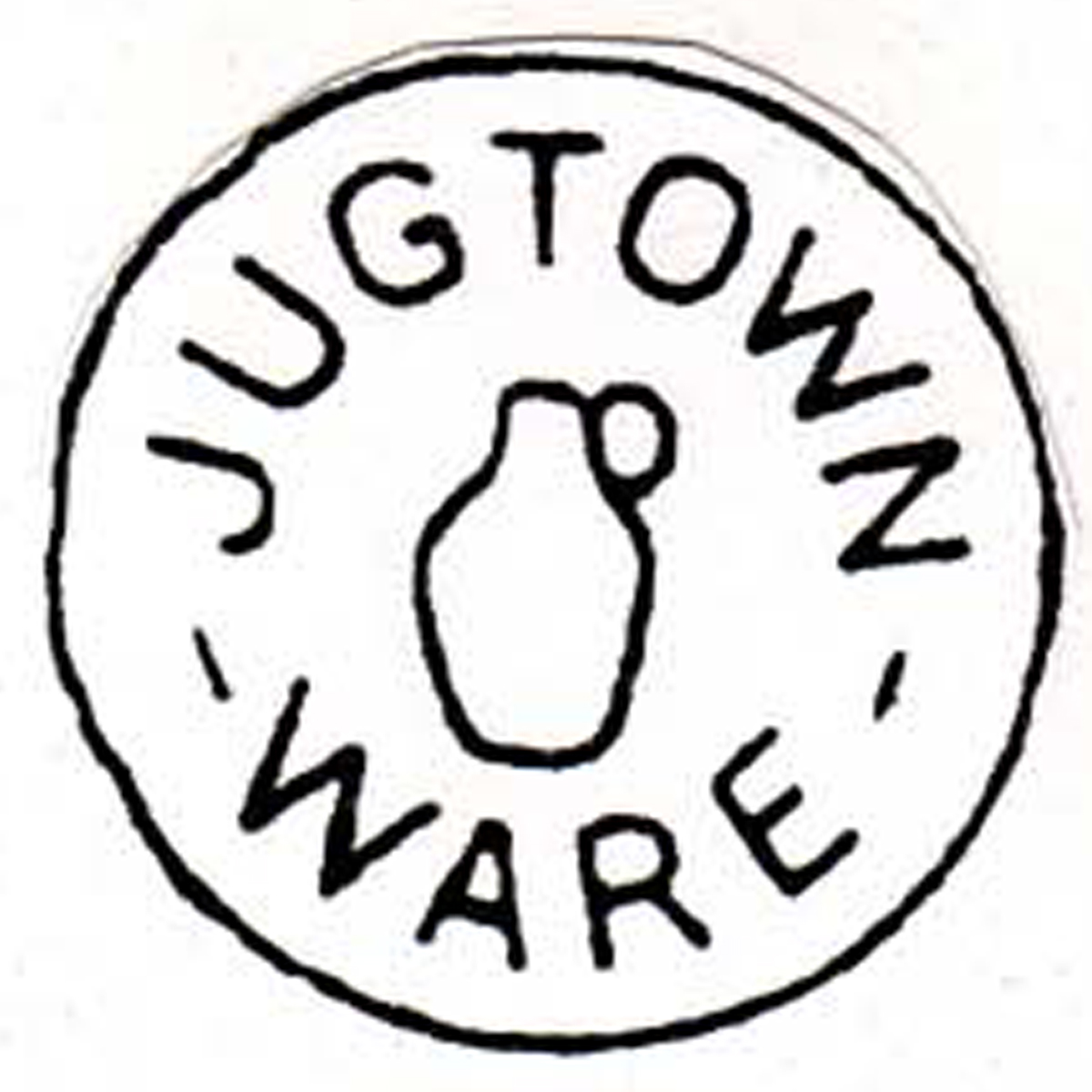
The way pots are marked
1-circular stamp with jug in center and Jugtown ware written around jug; Impressed in base of piece
year piece was made, stamped on base of piece
signature Vernon Owens incised in base or initials VO stamped on base
2- circular stamp with pitcher in center and Jugtown ware written around pitcher; Impressed in base of piece
year piece was made, stamped on base of piece
signature Vernon Owens incised in base or initials VO stamped on base
3-used rarely, a stamp from 1960
-circular stamp with jug (with a round top) in center and Jugtown ware written around jug; Impressed in base of piece
year piece was made, stamped on base of piece
signature Vernon Owens incised in base or initials VO stamped on base
PUBLIC COLLECTIONS
Gregg Museum of Art and Design, Raleigh, North Carolina
Museum of International Folk Art, Santa Fe, New Mexico
Smithsonian American Art Museum, Washington, D.C.
BIBLIOGRAPHY
Eaton, Allen. Handcrafts of the Southern Highlands. 1937. Reprint. New York: Dover Publications, 1973.
Eidelberg, Martin. “Art Pottery.” In The Arts and Craft Movement in America 1876-1916, editor Robert Judson Clark, 119-86. Princeton, NJ: Princeton University Press, 1972.
Levin, Elaine. The History of American Ceramics 1607 to the present. NY: Harry N. Abrams, Inc., 1988.
Perry, Barbara, ed. American Ceramics The Collection of Everson Museum of Art. New York: Rizoli,1989.




Citation: "The Marks Project." Last modified April 19, 2016. http://www.themarksproject.org:443/node/3686